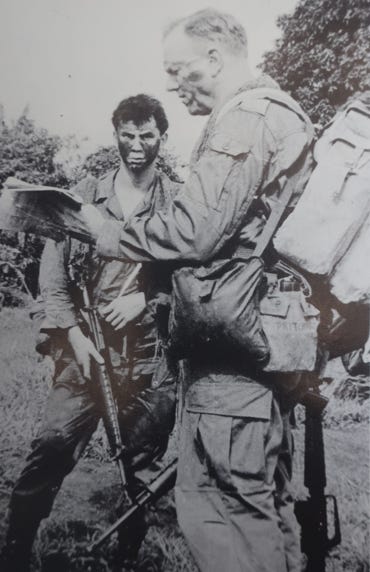
Major Phil Pritchard wearing his WW2 commando bergen while serving as a company commander in South Vietnam - 26 years earlier, he was a commando fighting in North-West Europe (The Grey Eight in Vietnam)
In 1970, Major Philip H.B. Pritchard, then serving with the 1st Australian Task Force in South Vietnam, took command of Alpha Company, 8th Battalion, Royal Australian Regiment, towards the end of its 12-month tour of duty. As one member of the battalion said, he was a good operator, but we all knew he was getting on a bit, and to an 19-year-old, the 47-year-old Major Pritchard was almost fatherlike. I first heard of him about twenty years ago, when in conversation with Vietnam veteran, the late Warrant Officer Don Dalton, a champion man in his own right, who remarked about Phil’s high level of fitness for his age, although he had been wounded in WW2 while serving with No. 6 Commando in North-West Europe, I was intrigued.
Philip Henry Biggerton Pritchard was born at Aberystwyth, Merionethshire, Wales, on 7th December 1923, the son of Henry George Pritchard, who had served with the Royal Artillery during the 1920s. In 1939, he was described as a student of High Road, Finchley and enlisted in the British Army in 1940. He initially served with the Territorial Army as a corporal in ‘A’ Squadron, 1st Royal Gloucestershire Hussars, that had become a home-based training unit. Then, in 1943, and most probably being frustrated with the mundane training role, he volunteered to serve with the commandos.
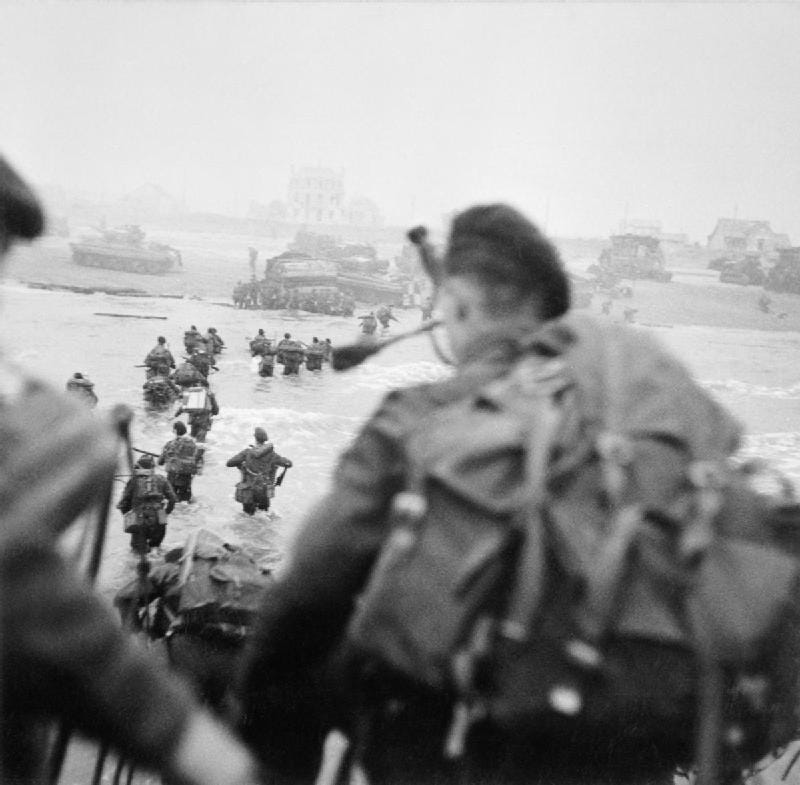
In order to join the commandos, he relinquished his stripes and was posted to No. 6 Commando, which formed part of the 1st Special Service Brigade under the maverick, Brigadier Lord Lovat. With No. 3 Troop, on D-Day, 6th June 1944, aged 21 years and having been in the army for four years, he landed at 08.40 am at Queen Red sector of the Sword Landing Area. As soon as they were ashore, No. 6 Commando had the honour of leading the brigade for the next three and a half hours until they relieved Major R.J. Howard’s ‘D’ Company, 2nd Battalion, Oxfordshire and Buckinghamshire Light Infantry that was holding what became known as Pegasus Bridge. No. 6 Commando had suffered 3 killed and 32 men wounded, of which Phil’s troop commander, the 23-year-old Captain Alan C.H. Pyman MC, was among the killed. The following month, he was promoted to corporal while still serving in Normandy, and six months later, on 24th January 1945, during Operation Blackwood in the Netherlands, Phil was wounded at Maasbracht. He re-joined the commando not long after, and having been promoted to sergeant, he took part in the operations in Germany, including the crossings of the Rhine, Wesser, Aller and Elbe rivers, and when the commandos were disbanded, he was posted to the 5th Royal Tank Regiment, then serving in Germany until he was discharged in 1946.
British Commandos landing at Queen Red sector of the Sword Landing Area on D-Day 6 June 1944 - a young Phil Pritchard among them (Imperial War Museum)
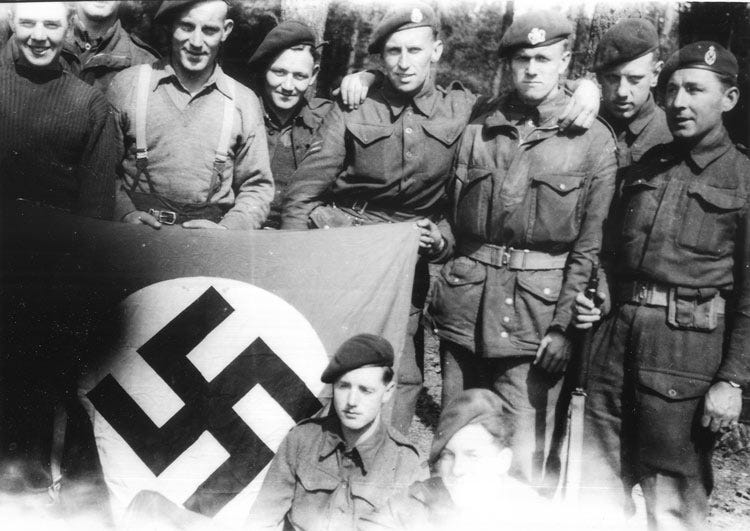
Corporal Phil Pritchard standing third from the right along with other members of No. 6 Commando in April 1945 (6commando.com)
Following the war, he re-joined the Territorial Army and served as a sergeant in the Royal Sussex Regiment; then, in March 1948, he transferred to the Royal Artillery. On 16th August 1950, he was posted to the 39th Battery, 411th Coastal Regiment (TA) and on 20th October 1950, when aged 27, he was commissioned a second lieutenant. On 17th July 1952, he relinquished his commission, and the following day, at Australia House, London, he enlisted in the Australian Regular Army which was a popular and common move at the time.
He arrived in Australia on 28th August 1952, and as part of the regular army cadre staff, he was posted as the platoon sergeant of 7 Platoon, ‘B’ Company, 14th National Service Training Battalion, then located at Puckapunyal, Victoria. In 1954, he received the Royal Victorian Medal, a rare award for an Australian, for his contribution to the 1954 Royal Visit of Queen Elizabeth II. As a sergeant, then later as a warrant officer class two and troop sergeant major, he served on active service in Malaya with the 105th Field Battery, ‘The Tiger Battery’ from 12th September 1955 until 19th November 1957. During this period, the battery fired in anger the first artillery rounds of the Australian Military Forces since WW2.
In 1959, while serving with the 1st Field Regiment, RAA, he was commissioned as a lieutenant in the Royal Australian Infantry Corps and was posted to the Army Apprentice School; then, in 1962, he was posted to the Royal Australian Army Service Corps Centre. He was promoted to captain on 17th January 1963 and on 28 May 1965, he deployed on operations to South Vietnam with Headquarters, 1st Australian Logistics Support Company. The following year, on 15th May 1966, he was posted as the second-in-command of ‘A’ Company, 1st Battalion, Royal Australian Regiment that was serving as part of the American, 173rd Airborne Brigade. He returned to Australia on 17th July 1966, having qualified for the US Meritorious Unit Citation that was presented to 1RAR. He was posted to the 2nd Recruit Training Battalion in 1966 and promoted to major on 21st July 1967, when he joined the newly formed 8th Battalion, Royal Australian Regiment, then serving in Malaysia and under the command of Lieutenant Colonel Joel O. Langtry DCM, a former WW2 platoon sergeant. A fellow company commander was Major Mike Jeffrey, later the Governor General of Australia from 2003 to 2008.
As the officer commanding, admin company, 8RAR, he arrived back in South Vietnam on 19th November 1969, where the battalion took part in arduous operations in Phuoc Tuy Province and, moreover, in the Long Hai Mountains. During the tour, he temporarily commanded both Alpha and Charlie Companies, of which, at 47 years of age, he was arguably one of the oldest infantry company commanders on operations, of which the younger soldiers were all aware that he was a former WW2 commando and even used a commando Bergen in the field.
Regarding Phil’s appointment to command Alpha Company, the battalion commander, Lieutenant Colonel Keith O'Neill, DSO, must have had confidence in him, as Alpha Company had been through a considerable number of contacts and mine incidents, in particular on 28th February 1970 in the Long Hai Mountains. Moreover, their former commander was the highly regarded Major Vincent ‘Vin’ Murphy, who was ex-SAS and had served previously with the Australian Army Training Team in 1966. One young national service private serving with Alpha Company, however, believed that Major Pritchard was ‘lacking in sensitivity and subtlety in man management.’
Phil returned to Australia with the battalion on 10th November 1970 and while the battalion was awarded the Vietnamese Cross of Gallantry Unit Citation with Palm, he was personally one of a small number of men to be awarded the Vietnamese Cross of Gallantry with Silver Star.
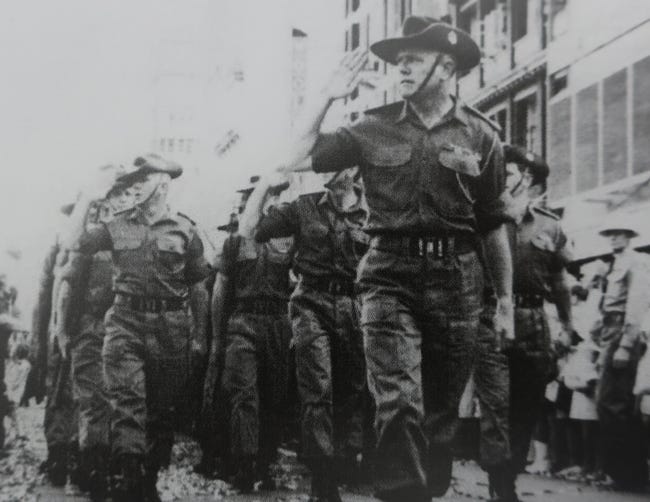
Major Phil Pritchard leading Admin Company, 8RAR through the streets of Brisbane immediately following their tour in Vietnam - it was the last time he served on active service (The Grey Eight in Focus)
A young second lieutenant recalled, looking back on his time serving under Phil Pritchard, as follows:
‘Phil was highly regarded - one look at his grey hair and ribbons was enough. He was stern, I never saw him socialize, I never saw him train, run etc. which was odd. He was fair and didn't suffer fools. Generally, we were stunned when he went to A Coy, but he never faltered in his leadership. I worked with him for a while before we deployed. I came back late from pre-embarkation leave and he matted me. I stood ram rod straight, never murmured and he tore strips off me. I was trembling at the finish. I recall too that he was more than displeased when some Digger while cleaning his pistol had an AD with the bullet striking his Herbie Brown peaked cap. A special and fine soldier.’
With the last of his active service over, in 1975, Phil was posted as the officer commanding the District Support Unit in Hobart, and the following year, he was appointed a Member of the Order of Australia. He retired from the Army on 7th December 1978, having been in uniform for 38 years, and then, ten years later, he retired from his civil employment in Tasmania as an associate to a Supreme Court Judge. Aged 93 years, he died in Tasmania on 25th October 2017 and while the WW2 commandos are all but gone, his 8RAR comrades have not forgotten him, of which, even this year at a reunion in Melbourne, his WW2 service was actively discussed.
References:
Imperial War Museum; Private papers of Major P.H.B. Pritchard
The Grey Eight in Focus
The Grey Eight in Vietnam
For further reading on No. 6 Commando and the men that served alongside Philip Pritchard, see the excellent resource: No.6 (Army) Commando (6commando.com)
Cam Simpson's History Substack is a reader-supported publication. To receive new posts and support my work, consider becoming a free or paid subscriber.


What an innings Cam! Well played.