

Lieutenant Crewe’s gallant deed
The man behind Frank Dadd’s painting, The gallant conduct of Lieutenant Fred Crewe

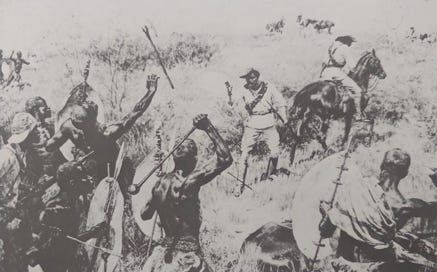
Lieutenant Fred Crewe when saving the life of Godfrey Hook.
Over the years while emersed in researching ninetieth-century colonial conflict in Southern Africa, I often came across Frank Dadd’s painting (above), The gallant conduct of Lieutenant Fred Crewe, and pondered over who Crewe was. Moreover, the man that he saved, Godfrey Hook, was the son of Major David Blair Hook, whom I had been researching for some time, and Hook had mentioned in his own writings how his son was saved from almost certain death by Fred Crewe.
Frederick Harding Crewe was born in Victoria County, Natal, on 3rd October 1868, the son of Samuel and Ellen Crewe, who emigrated from England in 1867 and were farmers of Umhlali. When he was nine years old, the Zulu War was being fought on his doorstep, of which his sixteen-year-old brother Percy D. Crewe served in the war as a trooper in the Durban Mounted Reserve. About the time that Mashonaland was occupied by the British South African Company, Fred Crewe accompanied his older brothers Percy and Richard to Mashonaland, where they embarked on mining ventures.
When the Matabele War broke out in 1893, Percy Crewe, the Zulu War veteran, joined the Salisbury Horse as a sergeant, while Fred Crewe, now 25 years of age, joined as a trumpeter, which suggests that he may have served with the volunteers at some point in Natal. It was during the battle of the Bembesi on 1st November 1893 that he received a severe gunshot wound to the right leg, which he never fully recovered from.
Following the Matabele War, he took part in an exploration mission across the Bembesi with George Grey, a fellow Salisbury Horse trooper, that lasted about a year. When the Matabele Rebellion broke out in 1896, George Grey raised Grey’s Scouts as its captain, while Fred, although he still suffered from his leg injury was appointed a lieutenant on 3rd April while his brother Percy enlisted as a sergeant. Three weeks later, on 22nd April, Grey’s Scouts form part of Captain Cecil Bisset’s patrol from Government House to the Umgusa River in Mashonaland, the force totaling 270 men. With Grey’s Scouts forming the advance guard, they came under fire from the rebels, and quickly, Bisset’s men were engaged on both sides of the river. Grey was ordered to advance 700 yards down the right bank, where they arrived and enfiladed the Matabele’s right flank. Having only been in action for several minutes, a large Matabele impi surprised Grey’s men, who rapidly started to extricate themselves.
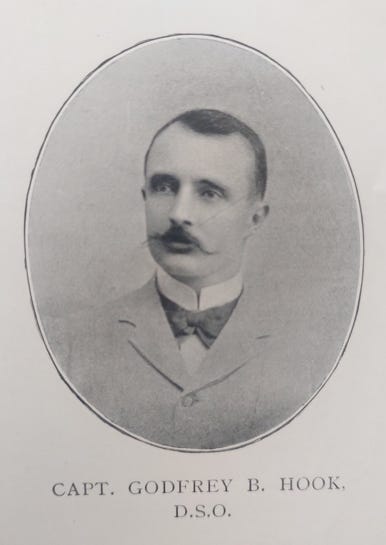
During the retirement, while several men became de-horsed, Lieutenant Godfrey Blair Hook, a 24-year-old colonial, was wounded and de-horsed—he was no novice, having been born and bred in the Eastern Cape and had served in the Cape Police and the Matabele War of 1893. Fred Crewe, seeing Hook laying seriously wounded with his dead horse under him, reined his horse about and galloped in to save him. Fred dismounted and got the wounded Hook onto his horse. With the Matabele closing in, he ran beside Hook until he was knocked down by a knobkerrie. Trooper J.H. Lester rode in and grabbed Fred, and in turn gave his horse to him, leaving himself alone. Close by, Trooper Frank W. Baxter gave up his horse to Trooper George Wise. Captain Grey, although wounded himself, rode in and assisted Baxter, who was soon killed, then he brought trooper Lester out of action. Baxter in 1907 was to be posthumously awarded the Victoria Cross for his actions this day, while Lester received the Distinguished Conduct Medal for saving Crewe; he was killed by a lion in January 1899. Fred Crewe and George Grey were each mentioned in dispatches for gallantry by General Fred Carrington, and in June 1896, Fred assumed command of Grey’s Scouts. Inspired by Fred’s bravery, Cecil Rhodes commissioned the celebrated British artist Frank Dadd to paint the action that resulted in The gallant conduct of Lieutenant Fred Crewe painting being presented to the Durban Town Council.
The three Crewe brothers remained in what was now called Rhodesia, and when the Second Anglo-Boer War broke out, Fred served as the captain and officer commanding ‘C’ Troop of the Western Division, Southern Rhodesia Volunteers. During the relief of Mafeking operations, Fred Commanded a small detachment known informally as Crewe’s Scouts, when on 30th March 1900, at Ramathlabama, only a day’s ride from Mafeking, while performing another act of gallantry, he was wounded and taken prisoner. He died of wounds on 2nd April 1900, of which his body was handed over by the Boers to the defenders near Mafeking, where he was buried. At 31 years of age, Fred Crewe had lived a life of adventure.
His brother Percy also served as an officer with the Rhodesians during the Boer War and died in 1931. His lone grave is located on the side of the road towards Victoria Falls. Richard, the other Crewe brother, served during the Bambatha Rebellion in 1906 as a trooper in the Transvaal Mounted Rifles, of which he formed part of its Native intelligence section. He died in Matabeleland in 1937. As for Godfrey B. Hook, he also served as a lieutenant with ‘B’ Troop, Southern Rhodesia Volunteers, during the relief of Mafeking and was awarded the Distinguished Service Order in 1901. He later became a Native Commissioner in Rhodesia and died at Wynberg, Cape Town, in May 1933, having had many years added to his life because of Fred Crewe’s selfless bravery at the Umguza River in 1896.
References:
BSAC Reports., The 96 Rebellions
Glass, Stafford., The Matabele War
Hickman, A.S., Rhodesia Served the Queen.
Hook, David., With Sword and Statute.
Rhodesiana., No. 30 June 1974.
Wills, W.A. and Collingridge, L.T., The Downfall of Lobengula.