

Born to Serve
Lieutenant Colonel Alexander George Syme DSO MM, Royal Scots and formerly Company Sergeant Major, ‘G’ Company, 2nd Battalion, Scots Guards

It could be said that Alexander George Syme was destined to be soldier as he was born into the Scots Guards at Chelsea Barracks on 28 April 1895, the son of Corporal William Adam Syme who was a diligent and well thought of soldier who not only held the Long Service and Good Conduct Medal but had served with the 2nd Battalion, Scots Guards in both the Sudan campaign of 1885 and during the Second Anglo-Boer War 1899-1902. While childbirth in the barracks was common at the time, Syme was to stand out, not only as a capable and diligent soldier, but as one of few soldiers to be decorated for gallantry in both World Wars, and one of a handful of soldiers to have enlisted as a boy soldier and retire as a lieutenant colonel, having held a battalion command.
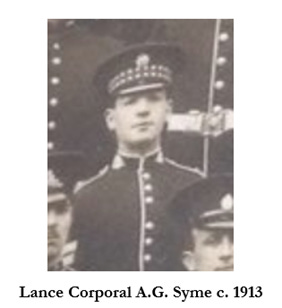
Styled as a musician, the athletic young Syme attested into the Scots Guards in London on 28 May 1909 aged just 14-years. Having joined his fathers’ old battalion, he was already well known to many of the senior NCOs of the 2nd Battalion. He soon showed sportsman like prowess by winning the 60 yards Boy’s swimming race and won the humorous Boy’s Apple Race (in which the runner up was Boy P.J. Sparkes, who retired as a major in 1949). Having completed his education courses, he, at the age of 18-years in April 1913, became a private adult soldier. On 11 September 1913, he was promoted to lance corporal and on the outbreak of war in August 1914, rather than deploying to Belgium with the battalion, he was posted to the Guards Depot, a posting that arguably saved his life as the 2nd Battalion under Lieutenant Colonel R.G.I. Bolton was severely mauled during the first months of the war. Many of the men that he had grown up and served with were either killed, wounded or taken prisoner of war, including the commanding officer.
Following a year at the Guards Depot he was posted to the London based 3rd (Reserve) Battalion on 13 August 1915 and promoted corporal and lance sergeant four days later. Finally, on 10 November 1915, he re-joined the 2nd Battalion on the Western Front and was posted to ‘G’ Company. This, however, was a much-changed battalion compared to that which had marched out of the Tower of London in October the previous year — they were now hardened veterans and had become, as one General Officer described the BEF as being, professional trench holders and losing their conventional open warfare skills.
He was promoted to sergeant on 19 February 1916 and when just aged 21-years on 18 August 1916 he was promoted to warrant officer class two and appointed the company sergeant major of ‘G’ Company at the height of the battle of the Somme. For bravery in the field while a platoon sergeant he was awarded, what was then the newly introduced Military Medal (London Gazette, 21 December 1916). As the savage winter of 1916/17 passed and the Germans tactically withdrew to the well-prepared Hindenburg Line, he was posted back home to the 3rd (Reserve) Battalion on 14 April 1917 with a view to a commission.
With the severe casualties on the Western Front, many NCO’s and men that had proved themselves in the trenches were recommended for commissions. Syme was one of these tested stalwarts who joined the 16th Officer Cadet Battalion on 23 April 1917 as an officer cadet and finally on 22 June 1917 he was discharged from the regiment that he had been born into and had known all his life; however, he still had many years of soldiering ahead.
Second Lieutenant Alexander George Syme MM having been commissioned into the Royal Scots in June 1917 was posted in November of the same year to the 17th (Rosebery’s Bantams) Battalion, Royal Scots on the Western Front that formed part of the 106th Brigade of the 35th Division. The division was seldom inactive and during the intense 100-Day offensive operations as the war was drawing to its conclusion, he was wounded on 29 September and evacuated home. He was promoted to Lieutenant on 27 December 1918 and posted to the 1st Battalion, Royal Scots.
By 1921, he was posted with the battalion to Rangoon and between 1923 – 1927 he served on attachment with the East Coast Battalion in India. Promoted captain on 28 November 1928 he was appointed the Adjutant of the 2nd Battalion, Royal Scots in July 1930 — an appointment he held until July 1933. Interestingly, the out-going Adjutant was Captain Alexander Gordon MC DCM MM who was a former sergeant in the 2nd Battalion, Scots Guards and at one point an ‘F’ Company man. One can just imagine the conversations and banter between these two old soldiers. On 1 August 1938, Syme was promoted to major after 29-years’ service and he probably thought his career was at its zenith, however, a crowded hour of fame and notoriety still awaited him.
Major Syme formed part of the British Expeditionary Force to France in 1939 and as the German Blitzkrieg was launched in May 1940, he found himself serving in the improvised ‘Beauman’ Division and from 3 June 1940 he was appointed an acting lieutenant colonel and commanding officer of the 4th Provisional Battalion that was composed largely of reinforcements. To the North, the evacuation from Dunkirk was taking place (27 May – 4 June), while Syme and the ‘Beauman’ Division were fighting a rear-guard action to Cherbourg. It was during this period at Isneauville, north of Rouen as the German 5th Panzer Division was assaulting south that Syme and his battalion, also referred to as ‘Syme’s Battalion’ made a determined stand to cover the continued fighting withdrawal of the division. Syme’s battalion put up a stubborn fight against elements of the 5th Panzer Division and through his shear tenacity, skill and leadership the battalion inflicted heavy casualties upon the enemy for which he was awarded an immediate Distinguished Service Order — the former boy soldier that had won the battalion apple race many years before was now successfully leading an infantry battalion during very trying times and against the greatest odds. The recommendation for the DSO submitted by Major General A.B. Beaman on 10 June and Gazetted on 20 October read as follows, and requires no further explanation as it stands for itself:
‘On June 8th this officer was in command of the 4th Provisional battalion with certain attached troops which was holding the divisional reserve positions astride the AMIENS-ROUEN rd. Owing to shortage of troops both flanks of the position were in the air. This officer had made his dispositions with great skill. He was attacked by enemy infantry, supported by tanks and artillery, at 16.15 hours. Under his skilled and determined leadership this small force held off the enemy for 3 hours. During this time 6 enemy tanks were destroyed, losses were inflicted on the enemy infantry, a body of parachutists were shot before they could land, and the plane carrying them was brought down. Previous to and during the action this Officer imbued his battalion, which was formed a few days previously from reinforcement personnel, with a fine fighting spirit, handled his battalion with determination, and carried out an orderly withdrawal as a formed body under enemy pressure. Throughout the operation he set an example of disregard of danger, and remained with the rearguard until contact with the enemy was lost’.
Having returned to England with the general BEF evacuation that was completed by 17 June, Syme relinquished his acting appointment on 20 July and on 6 August 1940 he received his DSO from His Majesty, The King — the same investiture that the widow of Lance Corporal Harry Nicholls Grenadier Guards received her husband’s Victoria Cross.
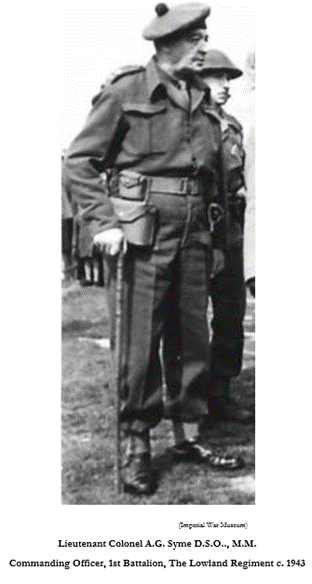
Syme went on to hold several appointments for the remainder of the war including the command of a battalion of the Royal Scots, being Mentioned-in-Despatches in April 1941 and in 1943 he raised and commanded the 1st Battalion, The Lowland Regiment. On 15 June 1946, he retired as an honorary lieutenant colonel. Quite an impressive period of service for a man who when just 5-years of age watched his father and the 2nd Battalion, Scots Guards sail to South Africa during the Boer War. For a short period, he resided in Kensington, London before emigrating to South Africa where he died at Cape Town in 1953.
Cam, he was 58 when he died. My hunch is that he was like many who had similar experiences; they had plunged to the depths of their reserves of fortitude.